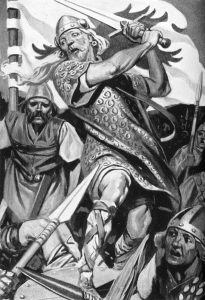
“Knebworth was probably a Saxon settlement. The Domesday spelling in 1085 is ‘Chenepeworde’, meaning ‘village on the hill’. Another more romantic interpretation is ‘Cnebba’s Camp’ suggesting the Knebworth was formerly home of Cnebba, the 5th Century Saxon prince.” So opens the Knebworth House guide book, and this has long been the official story on the origins of our village.
The Press Release recently sent out for ‘Knebworth Watch’, the Virtual Reality App developed as part of our Watchman’s Tower project (available to download for free from the Apple Store and the Play Store), offers the user “a journey through history showing what Knebworth House and the Park may have looked like in Anglo-Saxon, Norman, Tudor and Victorian times, up to the modern day.”
‘Probably’? ‘Maybe’? This hill of Knebworth, at 450 feet above sea level, is the highest point on the London to Edinburgh road between London and York. Of course there was a Saxon settlement here. Why would you not have a fortified camp on this most strategic spot? This was the front line in the battle against the marauding Danes, repelled by the brave Saxons only to make it as far as the village of Dane End on the other side of the valley.
Yes, I know Wikipedia says Dane End simply means ‘valley ends’. But where’s the story in that? What does Wikipedia know? We descendants of Prince Cnebba, with our roots in this ancient fortified Saxon hill of Knebworth, know better. We know never to let the truth get in the way of a good story!
Henry Lytton Cobbold
@HenryCobboldKH