June 2019

I have just returned from Jekyll Island in Georgia, just above its border with Florida.  My mission was to visit the Jekyll Island Museum and Archive.  The Archive contains the collection of the Jennings Family, wealthy partners in Standard Oil alongside the Rockefeller family.  The Jennings family rented Knebworth House in the 1920s and the photographs they took – on glass negatives – are unusual in that they were hand coloured.  So, although they are not natural colour photographs, they are the earliest colour photos that exist of Knebworth House and Gardens.  They are beautiful, and I hope we can put copies of them on display at the House in the future.

I learnt on the island that the Jennings family contacted the Jekyll family while they were in England and were given a portrait of the man after whom the island was named.  In 1733 Sir Joseph Jekyll had contributed £600 toward the founding of the colony of Georgia.  The Jennings also discovered that the island’s name had been missing an ‘l’ for a couple of hundred years.  This was put right by the Georgia Legislature when they got home.

It is very possible that the introduction to the Jekyll family came through my great-grandfather’s brother-in-law Edwin Lutyens, whose close associate was the garden designer Gertrude Jekyll.  Gertrude Jekyll designed our lovely herb garden at Knebworth House.  Of course we pointed out that, not only had they got the spelling wrong, but they were now pronouncing the name of their island incorrectly.  The Jekyll family pronounce their name not Jek-yll, but Jee-kyll.  Somehow I suspect the Georgia Legislature will not be springing to pass legislation to correct this!

Henry Lytton Cobbold
@HenryCobboldKH
Posted in 2019 | Comments Off on June 2019

May 2019

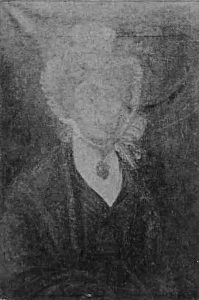
It’s extraordinary what pops out of the woodwork… or in this case, the plasterwork.  A radiator leak in Park Gate House (the last house on the right before Nup End), meant a ceiling had to be re-plastered.  During the work, this photo of a woman fell from under the floorboards of the room above.  All that is written on it is “Paton & Humphrey, Photographers, Kilmarnock and Campbellton”.

‘Cambellton’ – here’s a mystery that’s right up the street of Knebworth House Archivist Jill Campbell (of the Scottish Campbells)!  Researching the photographers, she discovered that they flourished at 123 King Street, Kilmarnock, between 1864 and 1867.  So was there a Scottish connection to the tenant at Park Gate House soon after this date?

Yes, there was.  A Matthew Gray and his wife were living there in the 1881 census, both born in Scotland.  Mr Gray was the Land Agent for my great-great-grandfather Robert Lytton (1831-1891).  He was dismissed from his post in 1891, although allowed to retain the tenancy of Broadwater Farm.  We don’t know the circumstances of the falling out, but mention is made in one of Robert’s letters that “the course he thought fit to take was not satisfactory to me”.  We know he had made himself unpopular with the hunting community, as the leader of a group of farmers who barred the local Hunt from crossing their farmland.  But more likely to have been an issue with the Lytton family was a “small dispute on the ice (presumably on the lake in Knebworth Park) between the skaters and curlers” in which Mr Gray supported the curlers.  The Lyttons have always been great skaters.

If you have a mystery that relates to Knebworth’s past, do contact Jill in the Knebworth House Archives to see if she can shed light on it – jcampbell@knebworthhouse.com.

Henry Lytton Cobbold
@HenryCobboldKH

Posted in 2019 | Comments Off on May 2019

April 2019

One of the more fun things we do at this time of the year is to restock our Knebworth House Gift Shop for the summer season.  We take delivery of boxes of dinosaur toys, dinosaur keyrings, dinosaur t-shirts… and, this year, dinosaur bubble blowers, which unfortunately got loose in their box and arrived having all taken a bath.  They’ve been sitting out to dry in our conference room, contributing to meetings, for a couple of weeks.  Then, with archery and jousting to look forward to on 21st/22nd April we need to make sure we have all the accoutrement for the aspiring young knight – made in plastic now, rather than at the blacksmith, but I think we can all agree that’s a good thing.  Then there’s Knebworth House chocolate.  Lots of that, of course.  Quite happy if that doesn’t sell and we have to finish it off before its sell by date at the end of the season.

Most fun for me, however, is hunting around for relevant books.  I think it’s important, after you’ve had a tour of Knebworth House and been told how influential the Bulwer Lytton family were in the literary world to see examples of their novels and biographies for sale in the Gift Shop, even if they’re quite difficult to find nowadays.  And I am pleased that, this year, we have also been able to restock Hugh Madgin’s excellent 2011 book “Knebworth Through Time”, which is 96 pages of fascinating views of our village, as it was, and as it is now.  This is not easy to find nowadays either – but, along with your dinosaur bubble blower, you can find it in the Knebworth House Gift Shop!

Henry Lytton Cobbold
@HenryCobboldKH

Posted in 2019 | Comments Off on April 2019

March 2019

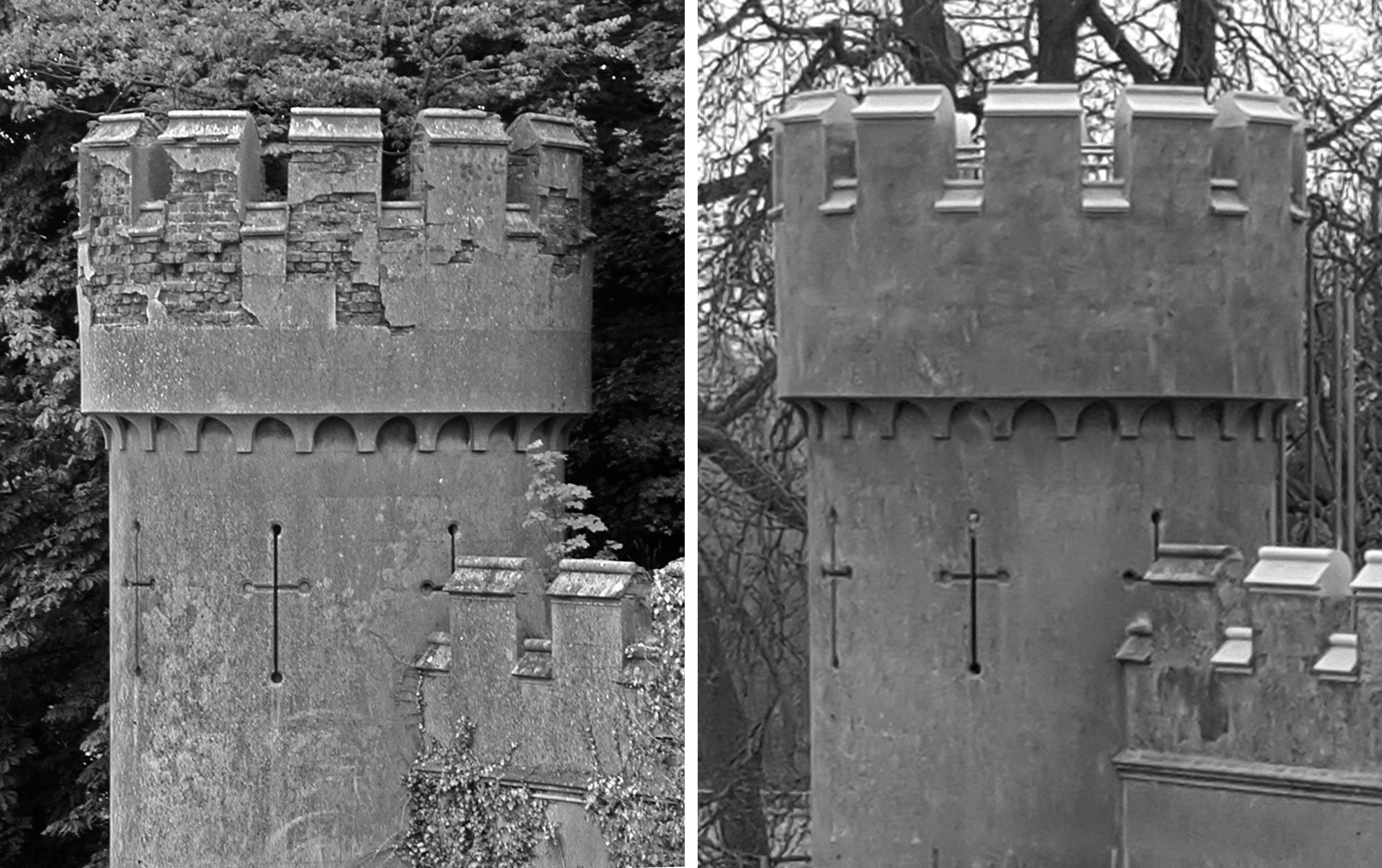
I’ve lived in Knebworth a long time, but I have never seen the Watchman’s Tower of Knebworth House look as good as it looks this morning.  For as long as I have known it, it has always looked unloved and crumbling.  Of course it’s never been the former, but it has always been the latter.  It’s simply that there’s always been more important worries regarding the masonry of Knebworth House.  And in truth there still are.  But sometimes it’s worth focusing on an individual project and making some visible progress.  It’s good for the spirit.

So, on behalf of the The Knebworth House Education and Preservation Trust charity, a big thank you to all who have added their support to make the Watchman’s Tower renovation possible, especially Historic England, the Country Houses Foundation and the Heritage Lottery Fund.  The scaffolding came down yesterday, and the results are to marvel at.

The Watchman’s Tower at Knebworth House ~ Before and After  
Only the exterior is viewable for the moment – we have to wait until the oak from Knebworth Woods dries before the internal staircase can be recreated later in the year – but I do encourage you to come and admire the work.  And what better day to do that than our Parish Open Day on Sunday 24th March.  Admission to the Park, Gardens and House will be free to everyone with a copy of the Parish News magazine (or proof that they live in the Parish).  Enter the Park via Old Knebworth, and the gate at St Mary’s – the only entrance for Parish Open Day – and there it will be, in all its splendidness, on your left… the Watchman’s Tower.

Henry Lytton Cobbold
@HenryCobboldKH

Posted in 2019 | Comments Off on March 2019

February 2019

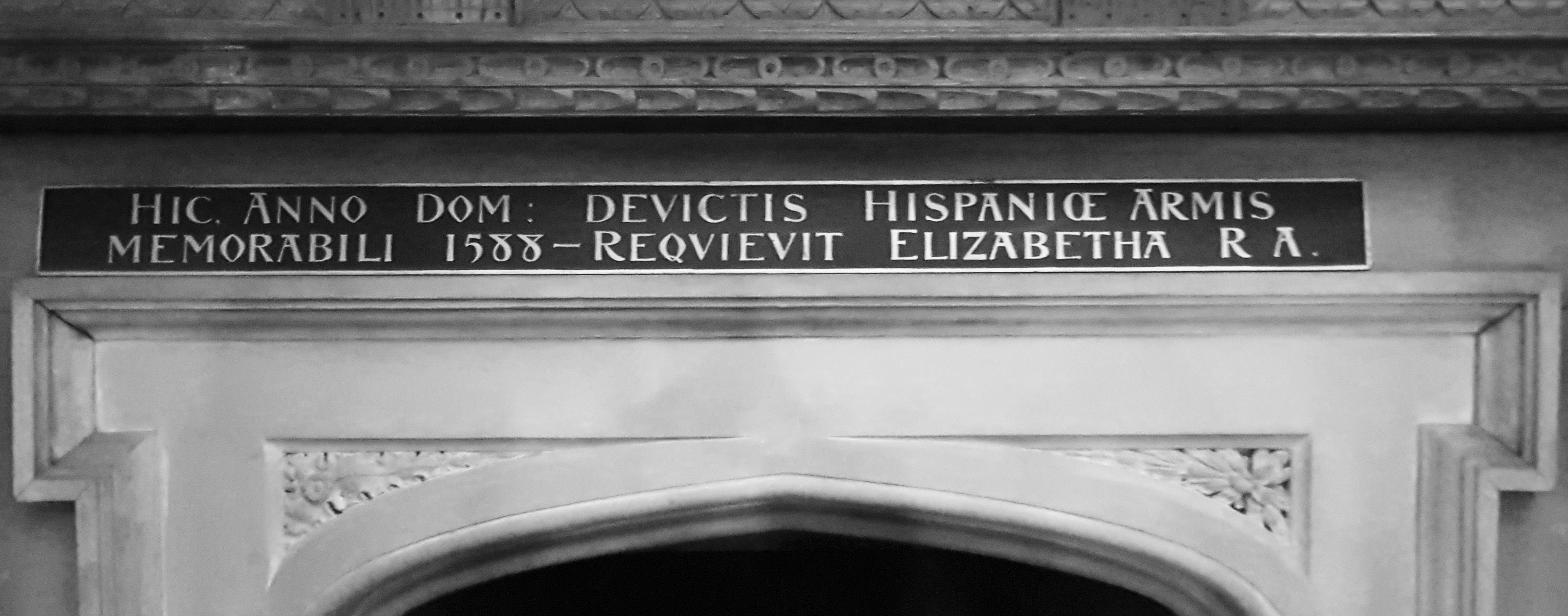
Our fascination with the Tudors and the Stuarts continues with a new film at the cinema about Mary Queen of Scots’ relationship with Queen Elizabeth I.  The film suggests that the two cousins met – rather bizarrely in a laundry, presumably for visual effect – despite there being no evidence of a meeting.  At Knebworth House an inscription above a bedroom fireplace suggests that Queen Elizabeth stayed here with the Lytton family in the year of the Spanish Armada, 1588 – but this inscription too, I’m afraid, we must accept is for visual effect and carries similar dramatic licence.

Inscription in the Queen Elizabeth Room, Knebworth House  
A remarkable work of research by the Cambridge academic Marion E. Colthorpe has tracked Queen Elizabeth I’s day-to-day travels – or ‘progresses’ as they were known – throughout her long reign.  These reveal that she did come to stay at Knebworth House, not in 1588, but on Tuesday 21st of August 1571.  She stayed for three days apparently, almost bankrupting the family with the preparations necessary.  The research also reveals that she came to dinner twice at Knebworth House before this, in 1566 and 1568.

Recently we thought that Mary Queen of Scots’ son King James I (of England, James VI of Scotland) chose to spend Christmas at Knebworth House in 1606.  We’d misread a quote from a letter saying that the King had been “at an inn in Ware, with his hawks” a couple of days before – but in fact it was the letter-writer that came on to Knebworth House, not the king.  Oh well.  Maybe we’ll use some dramatic licence there too.  Our Dining Parlour does have a couple of King James’s sofas – maybe we’ll say he stopped by for a sleep over at some point!

Henry Lytton Cobbold
@HenryCobboldKH

Posted in 2019 | Comments Off on February 2019

January 2019

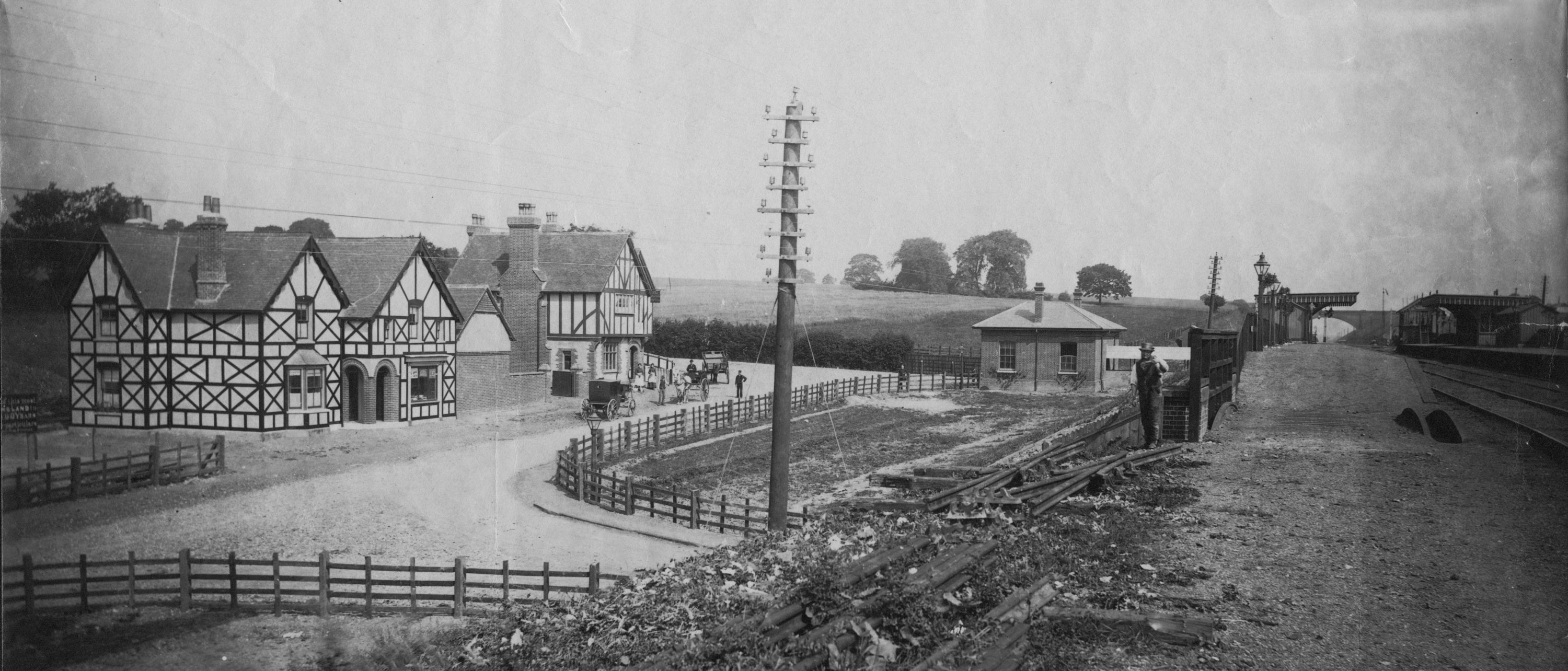
I was pleased to be able to make a statement in support of the Parish Council and Save Our Station Pub at the Public Inquiry.  I was able to explain why The Station Inn is New Knebworth’s only pub, despite Knebworth now being the largest village in Hertfordshire.  For those not familiar with the history, this is because prior to my great-great-grandfather, Robert Lytton, negotiating the opening of a Railway Station in 1884, there was no village here.  What we now know as Knebworth was farmland at the west end of Datchworth Parish.

With the railway station came a new settlement called ‘Knebworth Station’.  The Station Inn – one of only a handful of residences – was built and leased to the Fordham Company with a restrictive covenant on us, the landowner, that no other ‘alehouse or beerhouse’ should be built or permitted to be built or any ‘house or premises to be used for the sale of intoxicating liquors’ within ‘a radius of one mile’, for 99 years (i.e. until 1982).  The community was so small that Fordhams didn’t want its lease devalued by us building competition.

Knebworth Station ~ the original name of what we now know as Knebworth Village

This covenant stayed in place despite the little hamlet of Knebworth Station becoming, in 1909, a much larger village.  My great-grandfather, Victor Lytton, inspired by the Garden City movement and the recent creation of Letchworth Garden City, initiated a scheme with his brother-in-law, the architect Edwin Lutyens, to create a new settlement around ‘Knebworth Station’ called ‘Knebworth Garden Village’.  The original plan for Knebworth Garden Village was larger even than today’s village.  Although the full scheme was not completed, the population of Knebworth increased from a few hundred to about 2,500 by the Second World War, and very little that was built before the Second World War deviated from this Knebworth Garden Village scheme.

I explained to the Inquiry that my family now, as The Station Inn’s previous owners, in turn, hold a restrictive covenant over the pub.  This is because the Fordham Company exchanged their lease for a freehold in 1931.  Any property that we sold during the time of Knebworth Garden Village was covenanted to protect the Garden Village vision – preserving green spaces within the community, preserving the generous width between the built frontage on either side of our roads and avenues… and preventing, where possible, infill – which, of course, makes a Garden Village no longer a Garden Village.

These restrictive covenants pre-date the Planning Authority, but I very much hope that we are able to keep the garden of New Knebworth’s only pub.  I hope that the area around the pub retains its width, life, lights and people – so that those using the Railway Station at all times of day and night can feel safe, and feel that they are arriving at the centre of our community, and not at the edge of a dormitory suburb.

The Station Inn is the original heart of New Knebworth.  A community needs its vital organs – to live and to breathe and to prosper – and I believe that The Station Inn pub is one of my community’s vital organs.

Henry Lytton Cobbold
@HenryCobboldKH

Posted in 2019 | Comments Off on January 2019

December 2018

Representatives from authors’ and musicians’ homes and museums from around the United Kingdom visited Knebworth House in November for the 15th annual LitHouses Conference.  Sir Walter Scott and James Boswell were represented from Scotland, Dylan Thomas from Wales, John Ruskin from the Lake District, the Brontës from Yorkshire… all the way to Benjamin Britten from the far east coast of East Anglia, Jane Austen from Hampshire and Thomas Hardy from Dorset.  A truly nationwide gathering.

The LitHouses Group at Knebworth House ~ November 2018 ~ www.lithouses.org
The topic was literary homes as an education resource and we had speakers from the Universities of Hertfordshire and Cambridge.  A portrait of Edward Bulwer Lytton watched over proceedings and – as a great patron of writers and writer’s causes who, with his friend Charles Dickens (also represented), created The Guild of Literature and Art (now part of the Artists’ Benevolent Fund) – I know my great-great-great-grandfather would have approved, and been delighted that his home was hosting such an august group representing the country’s greatest authors and composers.  I suspect he was present.

As his good friend wrote – exactly 175 years ago – “A Merry Christmas to us all; God bless us every one!”

Henry Lytton Cobbold
@HenryCobboldKH

Posted in 2018 | Comments Off on December 2018

November 2018

The Knebworth House Education and Preservation Trust (KHEPT) has never in the past succeeded in getting a grant from the Heritage Lottery Fund.  Not for want of trying.  The charity has put together expensive applications three times since the 1990s and has been turned down every time.  Until now, that is.  And like buses, two successful applications have arrived at the same time!

The first was initiated by Stevenage Museum, working with Youth Connexions Hertfordshire, North Herts Museum, the Garden City Collection and KHEPT.  This is a grant for the project ‘Stevenage and North Herts Suffrage Stories: 100 years of votes for women’, which looks at key players in the national movement who have links with our area, like our own Constance Lytton.   Alongside new research, exhibits and a programme of events, a new book will be produced and launched at Knebworth House in the Spring.

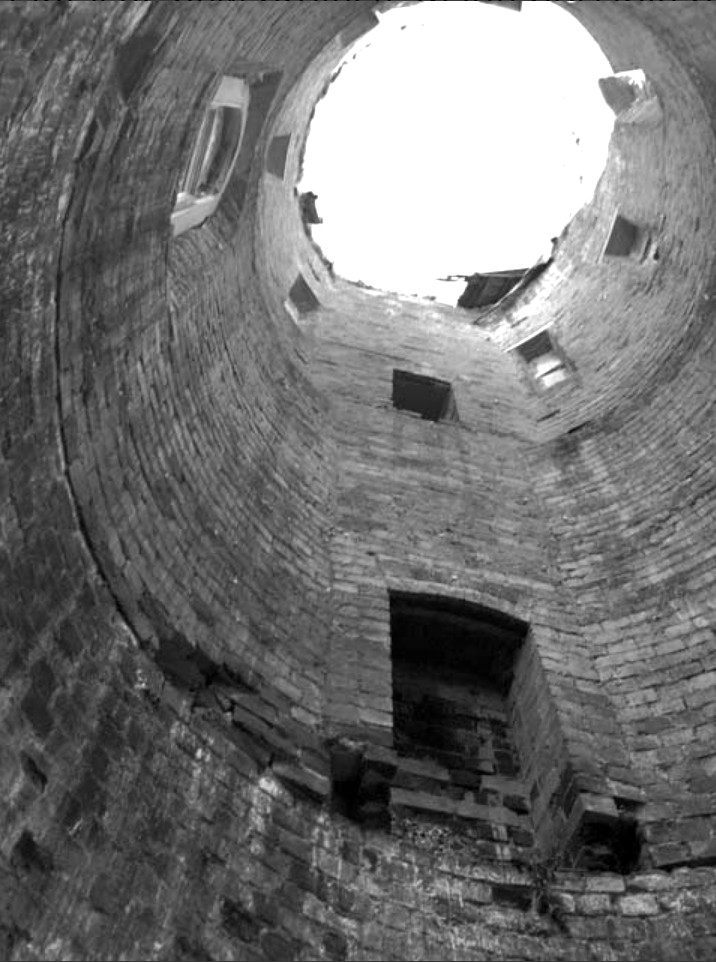
The second Heritage Lottery Fund grant is a contribution to the restoration and educational interpretation of Knebworth House’s Watchman’s Tower, which has been derelict since the Second World War.  The pigeons that have been squatting in this roofless tower are being moved on, the walls and exterior stucco repaired, and the floors and a staircase reinstated.  This will allow visitors a spectacular view from the hilltop, overlooking not only the exterior of Knebworth House, but also St Mary’s Church and the surrounding countryside to the north and east.  We will be re-imagining how this view looked at various points in history.

Interior of Knebworth House Watchman’s Tower – until 2018

All here are excited about both these projects, and very grateful to the Heritage Lottery Fund for its support.

Henry Lytton Cobbold
@HenryCobboldKH

Posted in 2018 | Comments Off on November 2018

October 2018

“Famous word that, innit, ‘Knebworth’?… You know, Led Zeppelin, ‘n’ all that…”
“Oasis…”
“Everyone… ‘Knebworth’!”
“Happy Mondays” “Happy Mondays!”
Shaun Ryder and Bez of the Happy Mondays – Knebworth Park 01.09.18

It was a happy Monday after the weekend of Cool Britannia last month.  An exciting return of live rock music to Knebworth Park after a three year hiatus.  The new festival was roundly praised as a fine new event for the summer calendar, and a great ending to the long hot summer of 2018.

The theme of the festival was the music of the 1990s, and it harked back to the record-breaking weekend in Knebworth Park in 1996 when the band Oasis, at the height of their fame and influence, played to a quarter of a million people.  The bands Ocean Colour Scene and Cast, who played with Oasis that weekend, were back, along with the Happy Mondays, the Lightning Seeds and other 90s favourites.

Cool Britannia 2018

I was worried before the event that anything that calls itself ‘cool’, is inherently not cool.  But what I witnessed was a great summer party of happy families enjoying themselves in the sunshine, and a healthy nostalgia for a time when what split the nation was a simple as whether you preferred Oasis or Blur.  Here’s to guitar bands, and the return of live rock music to Knebworth Park!

Henry Lytton Cobbold
@HenryCobboldKH

Posted in 2018 | Comments Off on October 2018

September 2018

There was excitement in our Archives recently when a newspaper cutting from July 1910 surfaced revealing that “Mrs. (Emmeline) Pankhurst addressed a woman suffrage meeting in the grounds of Knebworth House. Lord Lytton and Lady Constance Lytton also spoke.”  We are delighted to have a record that Mrs Pankhurst visited Knebworth.  She will have spoken in what we know as ‘The Lytton Hall’, on our drive off Old Knebworth Lane, which is now home to a company making holograms.  If only they could make holograms of the ghosts of the fascinating characters who’ve been in that hall!

You can see suffragettes in Knebworth Park this September – in the place Mrs Pankhurst would speak now if a venue was needed – the Knebworth Park Barns.  On Sunday 16th there will be two performances (2pm & 7pm) by the Hertfordshire-based theatre company Pins & Feathers of a new drama with music marking the 100th anniversary of women’s suffrage.  “The March” features the extraordinary Great Pilgrimage of 1913, in which thousands of women from all over the country marched to London to demonstrate peaceful mass support for the vote.  Marchers came down the Great North Road and passed along the brand new High Street of the village of Knebworth.

I will be taking part in a panel discussion after the 7pm performance, to talk about the role of my great-great-aunt Constance.  Do come if you can – details on our website – and if you haven’t yet seen our Archivists’ excellent new exhibit on Constance and her sacrifice for suffragette cause, it remains on display in Knebworth House on weekends through the end of September.

Henry Lytton Cobbold
@HenryCobboldKH

Posted in 2018 | Comments Off on September 2018